Trace LiveKit Agents with Langfuse
This guide shows you how to integrate Langfuse with LiveKit Agents for observability and tracing of real-time voice AI applications. By following these steps, you'll be able to monitor, debug, and evaluate your LiveKit agents in the Langfuse dashboard.
What is LiveKit Agents? LiveKit Agents (GitHub) is an open-source Python and Node.js framework for building production-grade multimodal and voice AI agents. It provides a complete set of tools and abstractions for feeding realtime media through AI pipelines, supporting both high-performance STT-LLM-TTS voice pipelines and speech-to-speech models with any AI provider.
What is Langfuse? Langfuse is an open-source AI engineering platform. It offers tracing and monitoring capabilities for LLM applications. Langfuse helps developers debug, analyze, and optimize their AI systems by providing detailed insights and integrating with a wide array of tools and frameworks through native integrations, OpenTelemetry, and dedicated SDKs.
Get Started
LiveKit Agents includes built-in OpenTelemetry support. The Langfuse SDK registers as an OpenTelemetry span processor, so all you need is to create a TracerProvider, hand it to both LiveKit and Langfuse, and traces will appear in your Langfuse dashboard automatically.
LiveKit Agents ships for both Python and Node.js. Select your language in the tabs below.
Step 1: Install Dependencies
pip install langfuse livekit-agents livekit-plugins-openai livekit-plugins-silero livekit-plugins-turn-detector opentelemetry-sdk python-dotenvnpm install @langfuse/otel @opentelemetry/sdk-trace-node @livekit/agents @livekit/agents-plugin-openai @livekit/agents-plugin-sileroStep 2: Configure Langfuse SDK
Set up your Langfuse API keys. You can get these keys by signing up for a free Langfuse Cloud account or by self-hosting Langfuse.
LANGFUSE_SECRET_KEY = "sk-lf-..."
LANGFUSE_PUBLIC_KEY = "pk-lf-..."
LANGFUSE_BASE_URL = "https://cloud.langfuse.com" # 🇪🇺 EU region
# Other Langfuse data regions include 🇺🇸 US: https://us.cloud.langfuse.com, 🇯🇵 Japan: https://jp.cloud.langfuse.com and ⚕️ HIPAA: https://hipaa.cloud.langfuse.com
LANGFUSE_SECRET_KEY = "sk-lf-..."
LANGFUSE_PUBLIC_KEY = "pk-lf-..."
LANGFUSE_BASE_URL = "https://cloud.langfuse.com" # 🇪🇺 EU region
# Other Langfuse data regions include 🇺🇸 US: https://us.cloud.langfuse.com, 🇯🇵 Japan: https://jp.cloud.langfuse.com and ⚕️ HIPAA: https://hipaa.cloud.langfuse.comStep 3: Set Up the Langfuse Tracer Provider
Create a shared TracerProvider and pass it to both LiveKit (via set_tracer_provider) and the Langfuse SDK. The Langfuse SDK automatically registers an exporter on the provider to send spans to Langfuse.
Because LiveKit generates many internal spans, set should_export_span=lambda span: True so that all telemetry is forwarded.
import os

from langfuse import Langfuse
from opentelemetry.sdk.trace import TracerProvider
from opentelemetry.util.types import AttributeValue

from livekit.agents.telemetry import set_tracer_provider


def setup_langfuse(
    metadata: dict[str, AttributeValue] | None = None,
    *,
    host: str | None = None,
    public_key: str | None = None,
    secret_key: str | None = None,
) -> TracerProvider:
    public_key = public_key or os.getenv("LANGFUSE_PUBLIC_KEY")
    secret_key = secret_key or os.getenv("LANGFUSE_SECRET_KEY")
    host = host or os.getenv("LANGFUSE_HOST") or os.getenv("LANGFUSE_BASE_URL")

    if not public_key or not secret_key or not host:
        raise ValueError(
            "LANGFUSE_PUBLIC_KEY, LANGFUSE_SECRET_KEY, and LANGFUSE_HOST (or LANGFUSE_BASE_URL) must be set"
        )

    trace_provider = TracerProvider()
    set_tracer_provider(trace_provider, metadata=metadata)

    Langfuse(
        public_key=public_key,
        secret_key=secret_key,
        base_url=host,
        tracer_provider=trace_provider,
        should_export_span=lambda span: True,
    )

    return trace_provider
Create a NodeTracerProvider configured with the LangfuseSpanProcessor and pass it to LiveKit via telemetry.setTracerProvider(). In OpenTelemetry JS SDK v2 (required by @langfuse/otel v5), providers are immutable, so the span processor must be supplied at construction time.
Because LiveKit generates many internal spans, set shouldExportSpan: () => true so that all telemetry is forwarded. Call tracerProvider.register() to also set it as the global OpenTelemetry provider, so spans from your own instrumentation (the OTel API or @langfuse/tracing helpers) are captured alongside LiveKit's.
Do not pass the metadata option to telemetry.setTracerProvider(). LiveKit handles that option by calling provider.addSpanProcessor(), an API that was removed in OpenTelemetry JS SDK v2 (which @langfuse/otel v5 depends on). Passing it throws TypeError: provider.addSpanProcessor is not a function and crashes the worker on job entry. To attach attributes to every span, add your own span processor to the spanProcessors array at construction time instead.
As of @livekit/agents v1.4.x, setTracerProvider() is still typed against OpenTelemetry JS SDK v1, while @langfuse/otel v5 uses SDK v2. The two NodeTracerProvider types are structurally incompatible, so TypeScript requires a cast. The cast is safe at runtime: LiveKit only calls getTracer() on the provider, which both SDK versions support.
import { NodeTracerProvider } from "@opentelemetry/sdk-trace-node";
import { LangfuseSpanProcessor } from "@langfuse/otel";
import { telemetry } from "@livekit/agents";

export function setupLangfuse(): NodeTracerProvider {
  const tracerProvider = new NodeTracerProvider({
    spanProcessors: [
      // LiveKit emits many non-LLM spans; forward all of them to Langfuse
      new LangfuseSpanProcessor({ shouldExportSpan: () => true }),
    ],
  });

  // Register as the global OpenTelemetry provider so that spans you create in
  // your own code (via the OTel API or @langfuse/tracing helpers) are also
  // exported to Langfuse, not just LiveKit's internal spans.
  tracerProvider.register();

  // Pass the provider to LiveKit WITHOUT the metadata option (see warnings above).
  // The cast bridges the SDK v1/v2 type mismatch; it is safe at runtime.
  telemetry.setTracerProvider(
    tracerProvider as unknown as Parameters<
      typeof telemetry.setTracerProvider
    >[0],
  );

  return tracerProvider;
}
Step 4: Use the Tracer Provider in Your Entrypoint
Call setup_langfuse() before AgentSession.start(). You can pass optional metadata (such as langfuse.session.id) that will be attached to every span.
from livekit.agents import AgentSession, JobContext, metrics
from livekit.agents.voice import MetricsCollectedEvent
from livekit.plugins import silero


async def entrypoint(ctx: JobContext):
    trace_provider = setup_langfuse(
        metadata={
            "langfuse.session.id": ctx.room.name,
        }
    )

    async def flush_trace():
        trace_provider.force_flush()

    ctx.add_shutdown_callback(flush_trace)

    session = AgentSession(vad=silero.VAD.load())

    @session.on("metrics_collected")
    def _on_metrics_collected(ev: MetricsCollectedEvent):
        metrics.log_metrics(ev.metrics)

    await session.start(agent=MyAgent(), room=ctx.room)
You can find a full end-to-end Python example on GitHub.
Call setupLangfuse() inside your agent entrypoint before the session starts, and flush the provider on shutdown so no spans are lost when a job ends.
import { type JobContext, defineAgent } from "@livekit/agents";

export default defineAgent({
  entry: async (ctx: JobContext) => {
    const tracerProvider = setupLangfuse();

    // Flush buffered spans when the job shuts down
    ctx.addShutdownCallback(async () => {
      await tracerProvider.forceFlush();
    });

    // ... start your AgentSession as usual (see the LiveKit Agents docs)
  },
});
Step 5: View Traces in Langfuse
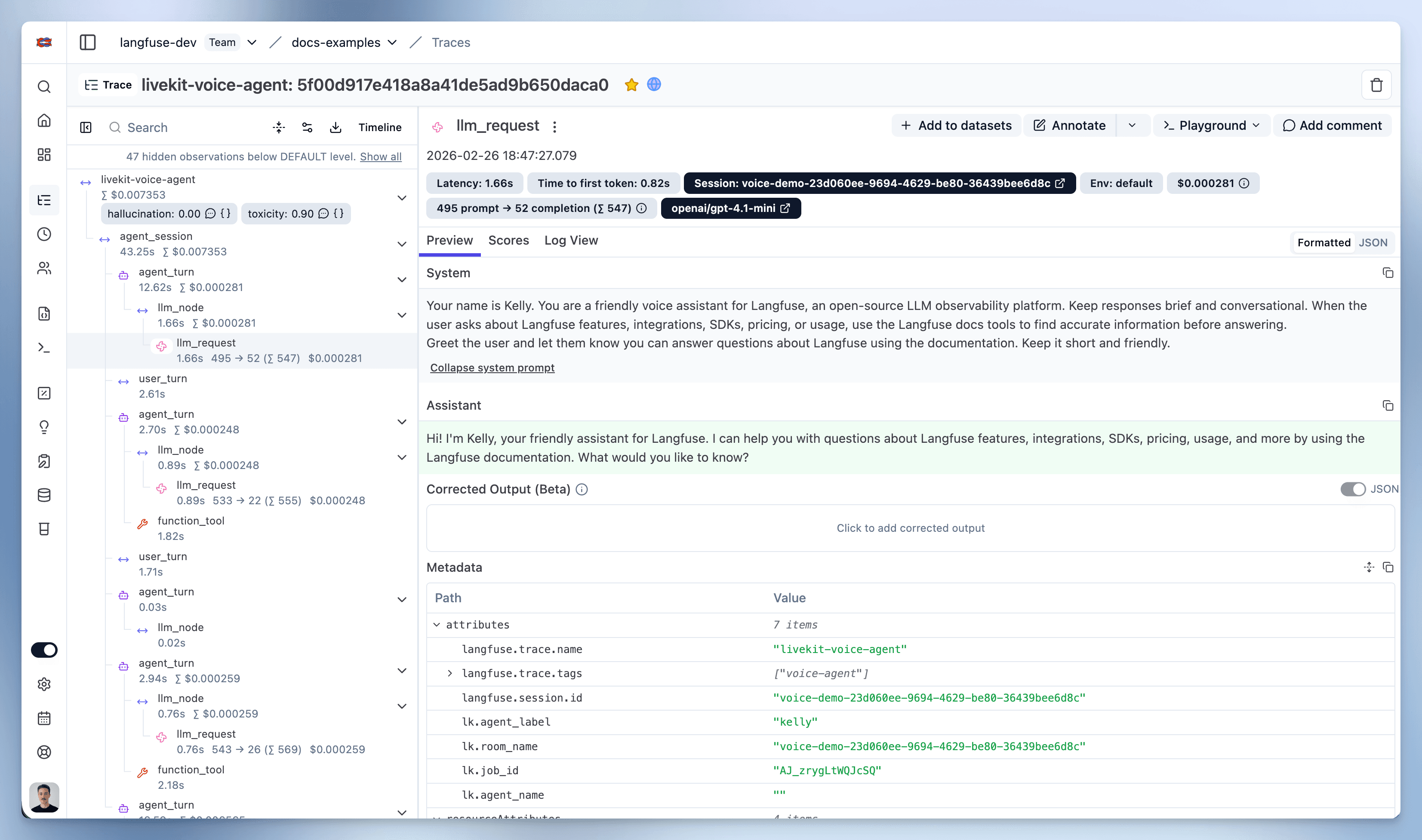
After running the agent, navigate to your Langfuse Trace Table. You will find detailed traces of the agent's execution, providing insights into every agent step, tool call, input, output, and performance metric.
Interoperability with the Python SDK
You can use this integration together with the Langfuse SDKs to add additional attributes to the observation.
The @observe() decorator provides a convenient way to automatically wrap your instrumented code and add additional attributes to the observation.
from langfuse import observe, propagate_attributes, get_client

langfuse = get_client()

@observe()
def my_llm_pipeline(input):
    # Add additional attributes (user_id, session_id, metadata, version, tags) to all spans created within this execution scope
    with propagate_attributes(
        user_id="user_123",
        session_id="session_abc",
        tags=["agent", "my-observation"],
        metadata={"email": "user@langfuse.com"},
        version="1.0.0"
    ):

        # YOUR APPLICATION CODE HERE
        result = call_llm(input)

        return result

# Run the function
my_llm_pipeline("Hi")
Learn more about using the Decorator in the Langfuse SDK instrumentation docs.
The Context Manager allows you to wrap your instrumented code using context managers (with with statements), which allows you to add additional attributes to the observation.
from langfuse import get_client, propagate_attributes

langfuse = get_client()

with langfuse.start_as_current_observation(
    as_type="span",
    name="my-observation",
    trace_context={"trace_id": "abcdef1234567890abcdef1234567890"},  # Must be 32 hex chars
) as observation:

    # Add additional attributes (user_id, session_id, metadata, version, tags)
    # to all observations created within this execution scope
    with propagate_attributes(
        user_id="user_123",
        session_id="session_abc",
        metadata={"experiment": "variant_a", "env": "prod"},
        version="1.0",
    ):
        # YOUR APPLICATION CODE HERE
        result = call_llm("some input")

# Flush events in short-lived applications
langfuse.flush()
Learn more about using the Context Manager in the Langfuse SDK instrumentation docs.
Troubleshooting
No observations appearing
First, enable debug mode in the Python SDK:
export LANGFUSE_DEBUG="True"Then run your application and check the debug logs:
- OTel observations appear in the logs: Your application is instrumented correctly but observations are not reaching Langfuse. To resolve this:
- Call
langfuse.flush()at the end of your application to ensure all observations are exported. - Verify that you are using the correct API keys and base URL.
- Call
- No OTel spans in the logs: Your application is not instrumented correctly. Make sure the instrumentation runs before your application code.
Unwanted observations in Langfuse
The Langfuse SDK is based on OpenTelemetry. Other libraries in your application may emit OTel spans that are not relevant to you. These still count toward your billable units, so you should filter them out. See Unwanted spans in Langfuse for details.
Missing attributes
Some attributes may be stored in the metadata object of the observation rather than being mapped to the Langfuse data model. If a mapping or integration does not work as expected, please raise an issue on GitHub.
Next Steps
Once you have instrumented your code, you can manage, evaluate and debug your application:
Manage prompts in Langfuse
Add evaluation scores
Run LLM-as-a-judge Evaluators
Create datasets
Create custom dashboards
Test queries in the Playground
References
GitHub Discussions
Last edited


